.svg)

Salary transparency has crossed a threshold. What began as a movement among a small number of progressive organizations has become a defining governance, talent, and technology issue for mid-cap and large enterprises. Regulatory mandates, labor market dynamics, and rising expectations around fairness and trust have converged to make transparency unavoidable.
Yet many organizations continue to approach salary transparency as a communications problem, something to be solved by publishing pay ranges in job postings or employee FAQs. This approach is dangerously incomplete. Transparency does not fix compensation systems; it reveals their strengths and exposes their flaws. When job architecture is inconsistent, ranges are poorly designed, equity analytics are underdeveloped, data infrastructure is fragmented, transparency amplifies inequity, confusion, and employer brand and employee relations risk.
The organizations that succeed take a fundamentally different view. They treat salary transparency as a compensation operating model, integrating role architecture, market pricing discipline, equity analytics, governance, manager capability, and HR technology into a coherent, defensible system. In this model, transparency is not only a regulatory burden, but a strategic capability: it reduces friction in hiring, strengthens pay equity outcomes and, most importantly, builds trust in how pay decisions are made.
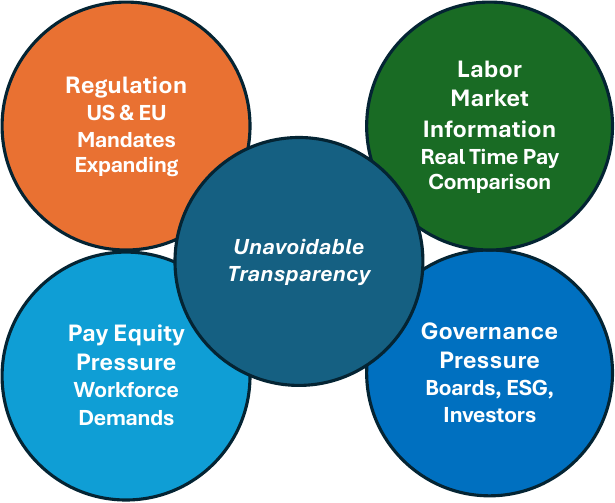
The rise of salary transparency is not the result of a single movement or ideology. It is the product of four reinforcing forces: 1) regulation, 2) labor market information, 3) pay equity expectations, and 4) stakeholder governance pressure.
First, in the U.S., regulatory gravity has created what is effectively a national standard through a patchwork of state and local laws. Colorado's Equal Pay for Equal Work Act requires employers to disclose good-faith pay ranges and benefits in job postings and to notify employees of internal opportunities.¹ California's SB 1162 expanded pay scale disclosure and pay data reporting requirements.² Washington State now requires wage or salary ranges and benefits in job postings and has issued guidance discouraging overly broad or non-credible ranges.³ New York State and Massachusetts have followed similar paths, with Massachusetts' law taking effect in 2025.⁴ ⁵ More states and jurisdictions are moving forward with legislation while this article is being published.
In a world of remote work and digital recruiting platforms, these laws do not remain local. Job postings are shared across state lines, candidates compare offers across markets, and employees see the same postings as external candidates. The practical result is that "complying only where required" is no longer operationally viable. Transparency expectations travel faster than legal boundaries.
Importantly, salary transparency is not uniquely American. Across the European Union, transparency has moved from principle to binding directive. The EU Pay Transparency Directive (2023/970) requires member states to implement national legislation mandating salary range disclosure in hiring, employee rights to comparative pay information, structured gender pay gap reporting, and joint pay assessments where unexplained gaps exceed defined thresholds.¹¹ The Directive also shifts aspects of the burden of proof to employers in pay discrimination disputes, materially raising governance expectations. In France, companies with 50 or more employees must calculate and publish a Gender Equality Index score and remediate deficiencies within prescribed timelines.¹² Germany's Pay Transparency Act provides employees in larger organizations the right to request median compensation information for comparable roles.¹³ In parallel, the United Kingdom and Australia require large employers to publish gender pay gap statistics, making pay equity data publicly searchable and reputationally salient.¹⁴
For multinational organizations, and increasingly for mid-cap firms with distributed workforces, this creates compounding operational complexity. A company with employees in California, Germany, and the United Kingdom is not managing three isolated compliance regimes; it is managing overlapping transparency architectures with different disclosure rules, reporting cadences, evidentiary standards, and enforcement mechanisms. In this environment, transparency ceases to be a local HR policy question and becomes a cross-border compensation systems challenge. Organizations that treat transparency as a posting requirement in one jurisdiction risk structural inconsistency across others.
The global reality of many companies reinforces that transparency is not a communications initiative; it is compensation infrastructure that must withstand a) regulatory audit, b) employee scrutiny, and c) public comparison simultaneously. Two features of the EU framework merit particular attention for multinationals. First, the Directive creates an enforcement architecture that functions differently from US litigation but carries equivalent financial severity: where an employer has failed to comply with pay transparency obligations, the burden of proof shifts to the employer to demonstrate the absence of discrimination, and compensation for workers who prevail is uncapped, encompassing back pay, related bonuses, lost opportunity costs, and non-material damages.¹⁶ Second, a governance tension that many organizations have not yet confronted: while disclosure is required under the Directive, antitrust compliance remains critical when publishing salary ranges. Organizations must avoid signaling market-wide wages or exchanging salary range information with competitors, an area of active scrutiny by the European Commission and national competition authorities.¹⁷ For organizations managing EU transparency compliance, this creates a cross-functional governance obligation that sits at the intersection of HR, legal, and finance, precisely the kind of challenge that bolt-on posting solutions cannot address.
Beyond regulatory mandates, salary transparency is increasingly being enforced through litigation, regulatory action, and public scrutiny. Early evidence suggests that non-compliance is not merely a technical risk but can be a material legal and reputational exposure for employers.
State labor agencies have begun investigating job postings that fail to include required pay ranges or that publish ranges so broad as to undermine "good faith" requirements. In parallel, plaintiffs' attorneys are increasingly testing transparency statutes through wage and hour claims, discrimination claims, and false advertising or misrepresentation theories when posted ranges materially diverge from actual offers.
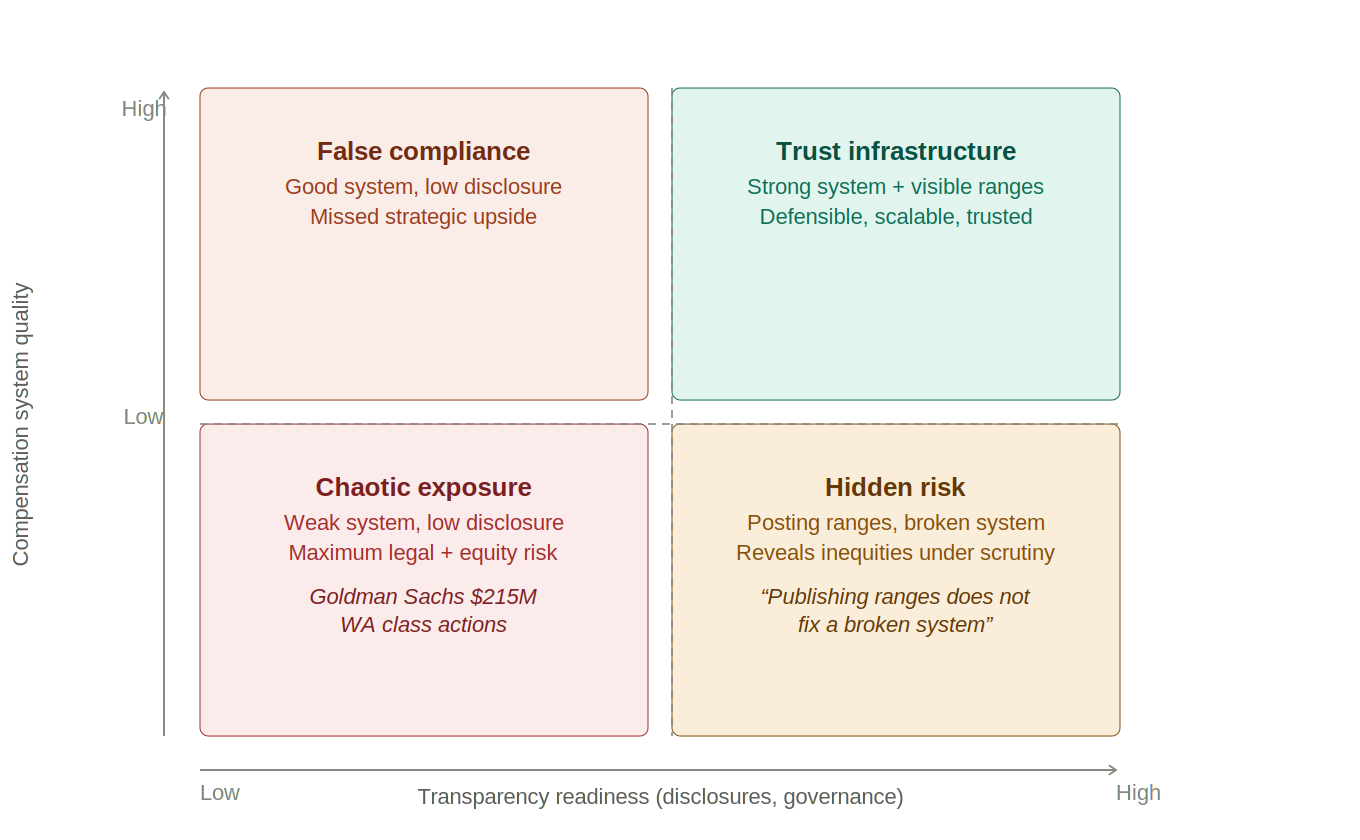
Washington State provides a leading indicator of how pay-transparency requirements can translate into litigation exposure. Since the state's 2022 amendments took effect, employers have faced a growing volume of class actions alleging non-compliant postings under the Equal Pay and Opportunities Act, often focused on missing ranges and missing benefits disclosures.⁶ Recent case law has also clarified threshold issues about who may sue as a "job applicant," increasing the importance of posting governance and auditability even for sophisticated employers.⁷
The Washington Supreme Court's September 2024 decision in Branson v. Washington Fine Wine & Spirits materially extended that exposure: the court held that any "job applicant" regardless of genuine or good-faith intent to seek employment could bring a statutory damages claim against an employer with a deficient posting. Because the legislature's 2025 amendments declined to define "applicant," the court's interpretation remains operative, creating durable standing for serial-plaintiff litigation. The financial stakes are concrete: Target settled a Washington posting class action for $2.25 million, and an IHOP franchisee settled a similar suit for $6.3 million, neither defendant having admitted wrongdoing.¹⁵ A further governance nuance: Washington's 2025 amendments clarified that the law does not apply to postings replicated without an employer's consent by third-party platforms such as Indeed or LinkedIn, closing a loophole that had exposed technically compliant employers to litigation based on distribution they did not control. The practical lesson is that posting governance, including oversight of third-party republication, is now a compliance infrastructure requirement, not a communications task.
At the market level, compliance remains uneven even after pay disclosure laws take effect, reinforcing that transparency is not merely a policy choice but an operational control problem. Analysis of online postings shows persistent non-compliance across jurisdictions, underscoring the limits of "bolt-on" approaches.⁸
Increased enforcement changes the cost-benefit calculus for leadership teams. Transparency is no longer simply about signaling values or improving candidate experience; it is increasingly about reducing legal exposure and managing downside risk. In this sense, fear and compliance are not cynical motivators, they are rational governance responses to a regulatory environment in which pay practices are becoming more visible, more contestable, and more legally actionable. This reality further reinforces the central thesis of this article: organizations that attempt to "bolt on" transparency without modernizing their compensation operating model and data infrastructure are not merely inefficient, they are assuming avoidable legal and reputational risk.
Despite the intensity of the debate, salary transparency is not a single practice. It exists on a spectrum. At one end is range transparency, where organizations publish pay ranges for roles to candidates and sometimes to employees. Moving along the spectrum is process transparency, which explains how pay is determined through job architecture, market pricing, and performance differentiation. Further still is outcome transparency, where organizations share pay equity results or remediation efforts. At the far end is full individual transparency, where individual pay is disclosed — an approach that remains rare and operationally fragile at enterprise scale.
For most mid-cap and large organizations, the sustainable equilibrium lies in range and process transparency, supported by selective outcome transparency. The objective is not radical openness for its own sake, but credible explainability, the ability to show employees and candidates that pay decisions follow a coherent, fair, and consistently applied logic.
This distinction matters because transparency is often misunderstood. It does not mean everyone is paid the same. It does not eliminate performance differentiation. And it does not require publishing every individual's salary. What it does require is something more demanding: a compensation philosophy that can be explained and withstand being seen.
When implemented well, salary transparency offers tangible strategic benefits. Hiring becomes more efficient as candidates self-select into roles with a clear understanding of pay expectations. Offer acceptance rates improve, and late-stage negotiation friction decreases. Internally, transparency acts as a forcing function for equity discipline: unjustified disparities surface and must be addressed. Over time, this strengthens trust in leadership decisions and clarifies the link between progression, skills, and rewards. Academic and practitioner research suggests that, under the right conditions, transparency can improve perceptions of fairness and organizational trust.⁹
At the same time, risks are equally real. Transparency can trigger employee relations shock when legacy inequities, pay-performance issues or compression are exposed without a credible plan for resolution. It can increase cost pressure by reducing informal negotiation variance and highlighting outliers that were previously invisible. It can create legal and compliance exposure in multi-jurisdiction environments if postings or practices are inconsistent. Unguided transparency can erode trust if ranges are so wide or so poorly governed that employees perceive them as meaningless.¹⁰
These risks explain why transparency efforts so often fail when they are treated as communications initiatives rather than structural reforms. Publishing ranges does not fix a broken system; it merely reveals it.
The central insight for CHROs and Heads of Total Rewards is this: salary transparency is an operating model decision. It requires five interdependent capabilities.
Salary transparency multiplies data exposure. In a transparent environment, inconsistencies in job data, stale market pricing, ad hoc exceptions, and spreadsheet-driven governance do not remain hidden; they become sources of friction, mistrust, and risk. This is why transparency initiatives so often fail in organizations whose compensation infrastructure was designed for opacity.
Core HRIS platforms are essential systems of record, but they are not systems of compensation intelligence. They store pay data, but they rarely provide dynamic market pricing, range design logic, embedded equity analytics, or governance workflows with audit trails. As transparency increases, organizations need decision-grade compensation infrastructure, not just payroll-grade data storage.
Modern compensation platforms integrate HRIS data, market benchmarks, job architecture, equity analytics, and governance controls into a single decision environment. They standardize range logic, embed equity analysis into planning and hiring workflows, enforce approval structures, and create auditability for offers, promotions, and off-cycle adjustments. In effect, they turn compensation from a series of episodic processes into a managed system.
Platforms such as Greatpoint HR exemplify this new category of infrastructure. They do not replace core HR systems; they sit above them, providing the intelligence, consistency, and governance layer that transparency requires. In transparent environments, technology becomes a risk control mechanism, reducing variance, documenting rationale, and creating defensible audit trails. In practice, compensation platforms and governed data workflows increasingly function like financial controls, reducing variance and enabling defensible oversight for regulators, employees, and boards alike. The urgency of building this infrastructure is reinforced by the pace of EU transposition.
Belgium's Wallonia-Brussels Federation became the first EU jurisdiction to transpose the Pay Transparency Directive into law in September 2024, with its decree taking effect January 1, 2025, and its requirements go beyond the Directive's baseline in several respects, including mandatory disclosure of salary ranges at the moment a job opening is announced (not merely before interview), and reporting on pay progression for employees on family-related leave.¹⁹ With the full EU transposition deadline set for June 2026, organizations with European operations face a compressing timeline to bring their compensation data infrastructure into compliance across jurisdictions that are each adding their own requirements above the Directive's floor. For multinational employers, this is not a future planning exercise; it is an active infrastructure readiness challenge.
There is also a generational dimension to this shift. The next generation of workers is entering organizations with fundamentally different expectations about information access and institutional trust. For them, transparency is not a perk; it is a proxy for whether an organization is trustworthy. Technology is the only way to deliver continuous transparency, at scale without collapsing under administrative complexity.
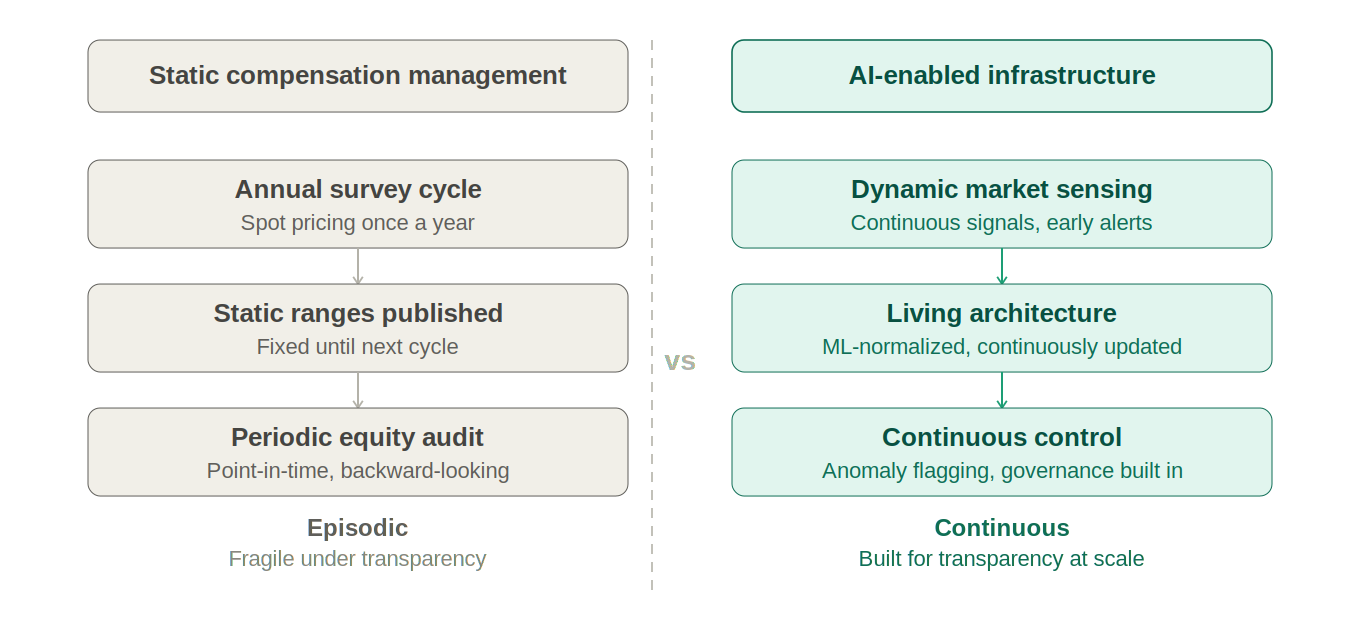
Artificial intelligence will fundamentally reshape how salary transparency is operationalized, governed, and experienced by employees. Importantly, AI does not replace the need for sound compensation philosophy or human judgment. It changes the speed, scale, and fidelity with which compensation systems can be maintained in transparent environments.
Historically, compensation infrastructure has been largely static. Job architectures are refreshed episodically, market pricing is updated annually or semi-annually, and equity analyses are performed at discrete points in time. This cadence made sense when compensation information traveled slowly and transparency expectations were limited. In transparent environments, however, these lagging systems become a structural liability. Employees see ranges in near real-time. Candidates compare offers instantaneously. Market dynamics shift faster than annual survey cycles can capture.
AI enables a move from static compensation management to dynamic market sensing. By ingesting continuous labor market signals, job posting data, skill premiums, geographic wage movements, and role demand patterns, AI-enabled platforms can refresh market benchmarks and flag emerging pricing risk much earlier than traditional survey cycles allow. This does not eliminate the need for disciplined market data sources, but it allows organizations to identify where their ranges are drifting out of market before employees or candidates experience the misalignment firsthand.
AI also materially changes the practice of pay equity analysis. Advanced models can surface complex intersectional patterns of inequity and compression that are difficult to detect through traditional regression approaches alone. This capability strengthens transparency by making inequities visible earlier and at greater scale. At the same time, AI introduces governance and explainability risk. In regulated pay environments, opaque models that cannot explain why a disparity exists create legal and employee relations exposure. For this reason, AI in compensation must be framed as decision support, not decision authority. Human judgment, legal oversight, and transparent model logic remain essential.
A third, underappreciated impact of AI is its role in scaling pay explainability. One of the most fragile points in transparency programs is the manager conversation. AI can support managers with context-specific explanations: why an employee sits where they do in a range, how skill acquisition affects progression, and what pathways exist for advancement. Done well, this transforms transparency from a policy into an everyday leadership capability. Done poorly, it risks automating tone-deaf or overly generic messaging. As with equity analytics, AI must augment — not replace — manager judgment.
AI will also reshape job architecture itself. Machine learning models can normalize job descriptions, cluster roles by skill similarity, detect leveling inconsistencies across geographies, and flag role drift as work evolves. Over time, this makes job architecture a living system rather than a periodic project. In transparent environments, this continuous refinement is critical. Static architectures degrade quickly when roles change faster than governance models can keep up.
Finally, AI introduces a new governance layer to compensation infrastructure. Embedded within modern compensation platforms, AI can flag anomalous offers, detect emerging patterns of exception abuse, and surface compliance risk before it becomes visible to regulators or employees. In this sense, AI shifts compensation governance from episodic review to continuous control.
The strategic implication for CHROs and Heads of Total Rewards is not that AI will "solve" transparency. It is that transparency at enterprise scale will increasingly be unsustainable without AI-enabled infrastructure. As expectations for speed, fairness, and explainability rise, particularly among younger workers who equate transparency with institutional trust, organizations that rely on static tools and manual governance will struggle to keep pace. AI does not eliminate the need for sound compensation design; it determines whether that design is operationally viable in a transparent world.
The path to sustainable transparency is sequential. Organizations must first define their transparency philosophy, what they will disclose, to whom, and when. They must then fix the system before making it visible: job architecture, range design, and equity diagnostics come first. Next comes operationalizing compliance and controls, followed by manager enablement and intentional communication. Only then should organizations consider expanding the depth of transparency over time.
Progress should be measured not only by compliance, but by outcomes: posting accuracy, offer acceptance rates, exception frequency, range penetration distributions, regrettable attrition, compression trends, and adjusted pay gap movement.
Salary transparency is not a cultural movement, rather it is a governance and operating model decision. In an era where trust in institutions is fragile and information flows freely, organizations will be judged not by what they say about fairness, but by whether their systems can demonstrate it.
The choice facing CHROs and Heads of Total Rewards is no longer whether transparency will arrive. It is whether they will design compensation systems that are ready to be seen, or inherit transparency chaotically, under regulatory pressure and employee scrutiny. The future belongs to organizations that treat transparency not as risk and exposure, but rather as infrastructure to build trust.