Market Pricing

Compensation Market Pricing That Moves as Fast as You Do

Consistent market pricing, clear methodology, and governance teams can stand behind. Import your trusted survey subscriptions, layer in proprietary insights, and benchmark pay with confidence, in minutes, not days.
No spreadsheets. Just smarter, faster decisions.
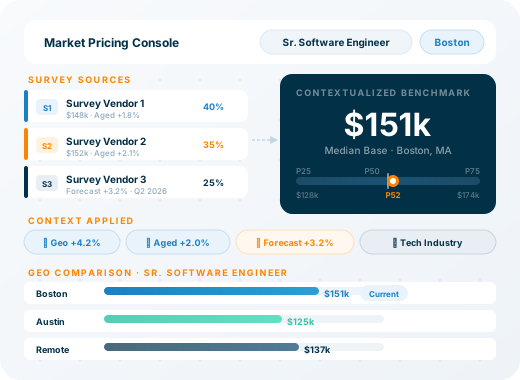
Market pricing console showing survey sources, contextualized benchmark, and geographic comparison
Pricing shouldn't take days. And it shouldn't leave gaps.
Survey data icon
Market data needs more than snapshots
Annual surveys are invaluable, but markets shift faster than release cycles, demanding fresh context, predictions, and multi-source integration to stay relevant.
Coverage gaps icon
Coverage gaps persist without integration
Even the strongest surveys have limits. Without seamless multi-source integration, teams end up with incomplete views and unnecessary guesswork.
Manual processes icon
Manual processes hold teams back
Aging, weighting, and reconciling data across spreadsheets is tedious, error-prone, and pulls focus from high-impact strategy.
The Fundamentals

What is compensation market pricing?

Market pricing is the process of valuing a role by comparing it to external market data for similar jobs, then translating that reference into pay targets and pay ranges. It helps organizations set compensation consistently across job levels, geographies, and talent markets while documenting how decisions were made.

The Process

How market pricing works: from pricing to benchmarking

A repeatable, defensible workflow that turns raw survey data into pay decisions your leadership can stand behind.

1

Select benchmark roles

Identify the jobs in your architecture that will anchor your pricing, typically the most common, well-defined roles.

2

Match roles to market jobs

Align your internal job titles to the closest comparable market survey jobs using consistent matching criteria.

3

Define the market

Set the parameters: geography, industry, company size, and any other cuts that reflect your talent competition.

4

Normalize and age data

Apply aging factors to bring older survey data to a current effective date and normalize across sources.

5

Build composites and percentiles

Combine multiple survey sources into a single weighted reference and calculate P25, P50, P75, and beyond.

6

Create pay references and ranges

Translate percentiles into market reference points (MRPs), pay targets, and min/mid/max pay ranges.

7

Benchmark internal pay

Compare your employees' actual pay to the market references to identify gaps, outliers, and compression risks.

8

Document decisions and export

Capture rationale, approvals, and versioning so every decision is auditable and leader-ready.

Everything you need to price with confidence.
From survey imports to geographic adjustments, Greatpoint HR handles the complexity.
Multi-source survey pricing
Import your existing survey subscriptions and combine them with our proprietary dataset in one platform. Weigh sources, apply aging factors, and get a single authoritative benchmark.
Proprietary market insights
Compensation-expert-built proprietary intelligence, historical trends, future forecasts, and dynamic economic and labor context alongside your surveys.
Geographic adjustments
Apply location-based differentials automatically. Whether you're pricing for Boston, Austin, or 50 markets at once, Greatpoint HR handles the math.
Aging and forward-looking context
Apply aging factors and layer in real-time economic and labor market signals so your benchmarks reflect where the market is today and where it is heading.
What You Get

Outputs you can defend

Every pricing run produces structured, auditable outputs: not just numbers, but a full record of how you got there.

Market references

  • Market reference point (MRP) / target pay
  • P25, P50, P75 percentiles
  • Location-adjusted variants

Pay structures

  • Pay range min / mid / max
  • Range spread and compa-ratio
  • Broadband and step structures

Benchmark insights

  • Pay positioning vs. market
  • Gaps, outliers, and overpays
  • Compression signals by level

Governance & reporting

  • Methodology rationale and notes
  • Audit trail, approvals, versioning
  • Leader-ready summaries and exports
Common Use Cases

When teams turn to market pricing

Whether you're running an annual cycle or responding to a one-off need, Greatpoint HR keeps the workflow consistent.

Price new roles and backfill roles fast
Refresh pricing for comp cycles
Benchmark pay to identify risk and gaps
Support remote and geo pay decisions
Harmonize pay after org change or growth
Calibrate job leveling changes
Don't take our word for it
"No one does what you're doing. The dashboards are where the industry should go. I can see exactly where we stand across every market in seconds."
Director of Total Rewards
Financial Services
"Managing our structures in other tools was a tangle of chaos. Greatpoint HR's structure management is hands-down the best in the industry."
VP of Human Resources
Healthcare Organization
"It addresses every pain point we were having with our previous tool. The interface is clean and the support is genuinely human, not a bot."
Senior Manager, Global Compensation
Technology Company
Why Teams Choose Us

Why teams choose Greatpoint HR for market pricing

Consistent job matching

Build a reusable matching library so every analyst prices the same role the same way: less debate, faster cycles, and results you can compare year over year.

Governance that leaders trust

Capture methodology, rationale, and approvals alongside every pricing decision. When leadership asks how you got there, you have the answer ready.

Faster cycles

Replace one-off spreadsheets with a repeatable, structured workflow. What used to take weeks (importing, aging, weighting, building ranges) now takes hours.

Clear reporting

Tell the story in plain language. Leader-ready summaries, visual range displays, and exportable outputs built for the audience, not just the analyst.

Market pricing vs. benchmarking: how they fit together

Market pricing creates the market reference: the MRP, percentiles, and pay ranges that define what a role should pay. Benchmarking then compares your internal pay to those references to show how competitive you are and what actions to take. Most teams do both as one connected workflow, price first and benchmark second, so the results are consistent and explainable. Greatpoint HR supports the full cycle in a single platform.

FAQs

Market pricing questions, answered

Common questions from compensation teams about methodology, data, and process.

Market pricing means using external market data for comparable jobs to estimate what a role "should" pay in a given talent market. The output is typically a market reference point (MRP) and supporting percentiles that can be converted into pay targets and pay ranges.
An MRP is a single market "anchor" value for a role, often aligned to a percentile like the 50th. It's used as the midpoint reference for pay decisions and range design. Some teams use MRPs by location, job level, or market cut, then roll them into standardized pay ranges.
P50 is common when you want to pay around market median for most roles. P75 is often used for scarce skills, high-impact roles, or markets where you need to lead pay to compete. The best choice depends on your compensation philosophy, hiring difficulty, internal equity goals, and budget. Many organizations mix percentiles by job family and level.
Geography is handled by choosing market cuts (e.g., national vs metro), applying location differentials, or pricing separate MRPs by location tiers. The key is consistency: define which geographies apply to which roles (remote vs on-site), document the logic, and ensure leaders understand how location impacts targets and ranges.
Job matching is the work of aligning your internal role to the best comparable market job(s). Benchmarking is the comparison of your internal pay to the market reference after roles are matched and priced. Strong matching improves accuracy; benchmarking turns the pricing into insights and actions.
Most teams re-price at least annually, often aligned to the compensation cycle. Roles in fast-moving labor markets (hot skills, high churn, rapidly changing geographies) may benefit from quarterly or semiannual refreshes. Re-price sooner after major changes like new job architecture, leveling updates, or rapid growth.
Composites combine multiple sources into a single reference by applying consistent rules, such as weighting by sample size, reliability, or vendor quality, and ensuring apples-to-apples cuts (geo/industry/size). The goal is a stable reference that reduces overreliance on any one survey while keeping the methodology reproducible and explainable.
Use a simple narrative: (1) what role we priced, (2) what market we used (geo/industry/size), (3) what comparable jobs we matched to and why, (4) what the market reference is and which percentile aligns to philosophy, and (5) the recommended pay range or action. Leaders respond best to consistency and documented rationale.

Book a Demo

See how Greatpoint HR helps compensation teams work smarter, move faster, and pay with confidence.
Book a Demo