Structures Management

Pay Bands Built on Real Data.

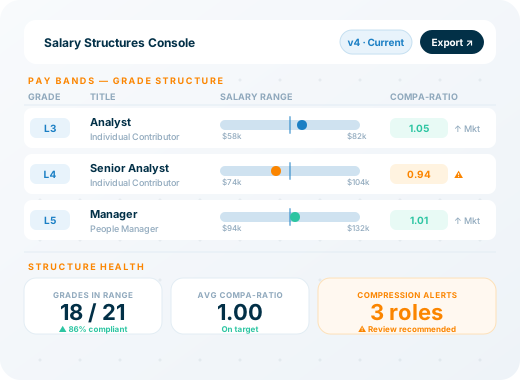
Design and maintain salary structures grounded in current market intelligence. Auto-propose ranges, run compa-ratio diagnostics, and keep everything versioned so leadership always knows where you stand and why.
No more spreadsheet chaos. Just structures that hold up.
Structures management console showing pay bands, compa-ratio diagnostics, and version history
Pay structures built in spreadsheets break the moment markets move.
Manual updates icon
Manual structure updates
Every market shift means another round of spreadsheet edits. Structures fall out of date fast and outdated bands cost you talent.
No defensibility icon
No defensibility
When leadership asks why a band is set where it is, you need data to back it up. Spreadsheet-built structures rarely have it.
Version chaos icon
Version chaos
Multiple versions floating around in email chains. No one knows which is current, who changed what, or why.
The Fundamentals

What is a salary structure?

A salary structure is a defined framework that organizes jobs into grades, bands, or levels and assigns pay ranges to each. The most common approach ties those ranges to external market data, with a minimum, midpoint, and maximum for each grade. Other organizations use point factor systems, broadbanding, step structures, or job-based pay. The right structure depends on the organization's size, philosophy, and workforce. What matters most is that the structure is documented, consistently applied, and grounded in a repeatable methodology.

The Process

How to build and maintain pay structures

A repeatable workflow that takes market data and turns it into defensible, current salary structures your organization can rely on.

1

Define your job architecture

Establish the job grades or levels your structure will cover. Align them to your career framework so every role has a clear home.

2

Anchor to market data

Use your market pricing results to set the midpoint for each grade. Choose a target percentile that reflects your pay philosophy.

3

Set range spreads

Apply range spreads appropriate to each level. Wider spreads for senior roles, narrower for more standardized positions.

4

Run compa-ratio diagnostics

Compare current employee pay to the new ranges. Identify who is below minimum, above maximum, or at compression risk.

5

Review and approve

Route the proposed structure through review. Capture rationale, approvals, and notes before the structure goes live.

6

Version, publish, and maintain

Publish the approved structure with a full version history. Refresh against updated market data each cycle without starting over.

Structures that stay current without the manual work.
Greatpoint HR connects your pay structures directly to live market data so they never fall behind.
Auto-proposed ranges
Greatpoint HR analyzes your benchmark data and automatically proposes salary ranges based on your organization's structure and philosophy.
Compa-ratio diagnostics
See instantly which employees fall below, within, or above their range. Identify compression issues and outliers before they become retention risks.
Version control
Every change is tracked. Roll back to any previous version, see a full audit trail, and always know who approved what and when.
Market-anchored updates
Refresh your structures against current market data each cycle. No more manual re-benchmarking. Your ranges stay grounded in what the market actually pays.
What You Get

Outputs you can defend

Every structure built in Greatpoint HR comes with the documentation and data needed to stand behind every band.

Pay ranges

  • Min, midpoint, and max for every grade
  • Range spread by level
  • Midpoint progression across grades

Diagnostics

  • Compa-ratio by employee and grade
  • Below-range and above-range headcount
  • Compression flags by level and job family

Governance

  • Full version history with change log
  • Approval workflow and decision notes
  • Market data source documentation

Reporting

  • Leader-ready structure summaries
  • Exportable range tables and visuals
  • Pay positioning analysis by team or org
Common Use Cases

When teams turn to structures management

Whether you are building from scratch or refreshing for a new cycle, Greatpoint HR keeps the process consistent.

Annual structure refresh for comp cycle
New structure design after job architecture change
Post-merger pay harmonization
Identifying compression and equity risks
Building the case for adjustment budgets
Replacing spreadsheet-based structure files
Don't take our word for it
"No one does what you're doing. The dashboards are where the industry should go. I can see exactly where we stand across every market in seconds."
Director of Total Rewards
Financial Services
"Managing our structures in other tools was a tangle of chaos. Greatpoint HR's structure management is hands-down the best in the industry."
VP of Human Resources
Healthcare Organization
"It addresses every pain point we were having with our previous tool. The interface is clean and the support is genuinely human, not a bot."
Senior Manager, Global Compensation
Technology Company

How structures connect to market pricing and benchmarking

Market pricing produces the market reference point for each role. That reference becomes the anchor for setting the midpoint of your pay range. Structures then translate those individual references into a coherent, consistent framework across all grades so pay decisions scale across the organization. Benchmarking closes the loop by comparing where your employees actually sit relative to those ranges. Greatpoint HR connects all three steps in a single platform so nothing gets lost between tools.

FAQs

Pay structure questions, answered

Common questions from compensation teams about building, maintaining, and defending salary structures.

A compensation structure is a defined framework that groups jobs into grades or bands and assigns a pay range (minimum, midpoint, maximum) to each. It ensures pay decisions are consistent, market-aligned, and defensible across the organization.
A pay band is the range of pay assigned to a job grade or level, typically defined by a minimum, midpoint, and maximum. Bands are set by anchoring to a market reference point (usually a target percentile), then applying a range spread that reflects the organization's pay philosophy and career progression expectations.
A compa-ratio is an employee's pay divided by the midpoint of their pay range, expressed as a percentage. A ratio below 100 means the employee is paid below the midpoint; above 100 means above. It is used to assess pay positioning, identify compression risks, and guide merit and adjustment decisions.
Most organizations review pay structures annually, aligned to the compensation planning cycle. Structures in fast-moving talent markets or with significant market shifts may warrant mid-year reviews. Triggering events like rapid headcount growth, new job architecture, or M and A activity can also prompt an off-cycle refresh.
Range spread is the percentage difference between the minimum and maximum of a pay range. Narrower spreads (40 to 50 percent) are common for lower-level or highly standardized roles. Wider spreads (60 to 80 percent or more) suit senior or highly variable roles where experience and performance create meaningful pay differentiation.
Pay compression occurs when newer or lower-level employees earn close to or more than longer-tenured or higher-level colleagues. It is addressed by regularly benchmarking internal pay against updated structures, identifying employees whose pay falls near or above the range maximum, and building adjustment budgets into compensation cycles.
Job levels describe the scope and complexity of work (such as Associate, Senior, or Principal). Pay grades are the structural buckets that assign a pay range to one or more job levels. Organizations sometimes map multiple job levels to a single broad grade, or maintain a one-to-one relationship depending on how granular their pay differentiation needs to be.
Defensible structures are anchored to documented market data, use a consistent methodology (target percentile, range spread rules, aging approach), and are versioned so every change is traceable. When leadership asks why a band is set where it is, you should be able to show the market data used, the decisions made, and who approved them.
Market pricing produces the market reference point (MRP) for each role. That MRP becomes the anchor for setting or validating the midpoint of the pay range. Structures then translate those individual MRPs into a coherent, consistent framework across all grades so pay decisions scale across the organization.

Book a Demo

See how Greatpoint HR helps compensation teams work smarter, move faster, and pay with confidence.
Book a Demo