Survey Management

Survey Management for Compensation Teams

Centralize, validate, and govern compensation survey data. Streamline job matching, reduce rework, and power faster market pricing from a single source of truth.
No more portal fatigue. Just clean, consistent, governed data.
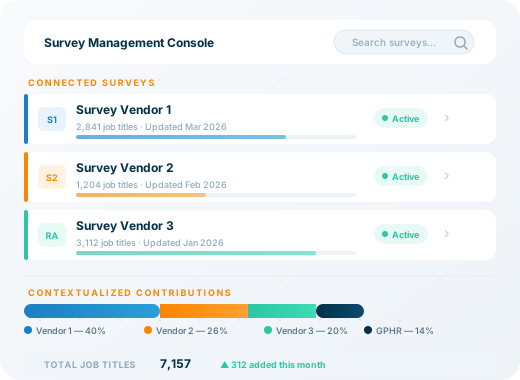
Survey management console showing centralized survey data and job matching workflow
Managing multiple surveys is a full-time job in itself.
Portal fatigue icon
Portal fatigue
Logging into multiple survey platforms, downloading exports, reformatting data before you have even started pricing.
Inconsistent formats icon
Inconsistent formats
Every survey provider delivers data differently. Reconciling formats manually introduces errors and eats hours you do not have.
No single source of truth icon
No single source of truth
When everyone on the team works from different exports, you get inconsistent benchmarks and conflicting answers.
The Fundamentals

What is survey management?

Survey management is the process of collecting, standardizing, mapping, and governing compensation survey data so it can be trusted for market pricing and benchmarking. It replaces one-off spreadsheet work with a repeatable workflow, documentation, and controls that keep decisions consistent year over year.

The Process

The survey management workflow

A repeatable, governed process that takes raw survey files and turns them into trusted inputs for market pricing.

1

Collect and centralize survey files

Bring every survey subscription into one platform. No more downloading exports or switching between portals.

2

Validate and standardize fields

Align job identifiers, geography definitions, pay elements, and effective dates. Flag missing fields or out-of-range values before they cause downstream errors.

3

Map survey jobs to your job architecture

Connect survey jobs to your internal job framework using consistent mapping rules your whole team follows.

4

Manage job matching decisions

Record matching rationale, capture peer review notes, and build a reusable library so matches are not reinvented each cycle.

5

Create survey composites

Combine multiple sources using explicit weights and rules. Store which sources were used and why for full reproducibility.

6

Approvals and audit trail

Route decisions through approval steps and capture a complete record of who approved what and when.

One platform for every survey you own.
Greatpoint HR centralizes your survey data so your team works from one consistent, always-current source.
Bring your own surveys
Import any survey subscription you own. Your data, your platform, no restrictions. Every source onboarded with repeatable mapping rules.
Unified benchmark view
All surveys normalized into one consistent format. No reformatting, no version conflicts. Every analyst prices from the same source.
Team collaboration
Everyone works from the same data. Share benchmarks, annotate job matches, and collaborate on pricing so nothing gets lost between handoffs.
Add proprietary context
Layer Greatpoint HR proprietary insights alongside your survey data to fill gaps and create a contextualized, unified view.
Governance

Built for governance, so pricing is defensible

When leadership asks how a decision was made, you have a complete record. Greatpoint HR captures the methodology, matching rationale, and approvals alongside every survey decision.

  • Roles and permissions by team member
  • Audit logs for every key decision
  • Consistent matching rules across analysts
  • Decision notes attached to each job match
Efficiency

Reduce cycle time and rework

Reusable matches, standardized formats, and consistent exports mean your team spends less time on setup and more time on strategy. What used to take days now takes hours.

  • Reusable job matching library across cycles
  • Fewer handoffs and version conflicts
  • Consistent exports ready for pricing
  • Faster onboarding for new surveys

Connect survey management to market pricing and benchmarking

Survey management is the foundation. Once your data is clean, mapped, and governed, it feeds directly into market pricing and benchmarking without extra steps or reformatting. Greatpoint HR connects the full workflow in one platform so your team moves from raw survey files to pay decisions faster and with more confidence.

Don't take our word for it
"No one does what you're doing. The dashboards are where the industry should go. I can see exactly where we stand across every market in seconds."
Director of Total Rewards
Financial Services
"Managing our structures in other tools was a tangle of chaos. Greatpoint HR's structure management is hands-down the best in the industry."
VP of Human Resources
Healthcare Organization
"It addresses every pain point we were having with our previous tool. The interface is clean and the support is genuinely human, not a bot."
Senior Manager, Global Compensation
Technology Company
FAQs

Survey management questions, answered

Common questions from compensation teams about managing survey data, job matching, and governance.

Most compensation teams manage multiple vendor surveys plus internal datasets. The practical requirement is that each source can be standardized into consistent fields: job, level, geography, sample details, and pay elements). If you define your standard schema, you can onboard new surveys with repeatable mapping rules.
Standardization means converting different survey formats into a consistent structure: aligning job identifiers, geography definitions, pay elements (base/bonus/total), and effective dates. It also includes validation checks for missing fields, out-of-range values, and mismatched cuts so the same pricing logic works across sources.
Job matching is aligning an internal role to the most comparable survey job(s) based on scope, responsibilities, skills, and level, not just job title. Good matching records the rationale and keeps it consistent across cycles so pricing is not reinvented each year.
Use shared guidance: matching criteria by job family and level, peer review or approval steps, and decision notes that explain why a match was made. Reuse prior matches as a baseline and flag changes when job structure or survey definitions shift.
Use a consistent market definition (geo/industry/size), standardize fields, and combine sources using an explicit composite method with weights or rules. Store which sources were used, what filters applied, and why, so results are repeatable and defensible.
A strong audit trail captures which surveys were used, which market cuts were selected, how jobs were matched, what composites and weights were applied, how data was aged and normalized, and who approved key decisions. This is essential for leadership confidence and for explaining decisions later.
Comp typically owns survey management because it is closest to job architecture, leveling, and pricing methodology. HR partners and Finance should be involved as stakeholders for governance, budget alignment, and approvals so the process stays consistent and credible.
Survey management ensures your inputs are clean, mapped, and governed so market pricing can run faster with fewer disputes. When survey data is standardized and job matches are reusable, you reduce rework and increase consistency across the org.

Book a Demo

See how Greatpoint HR helps compensation teams work smarter, move faster, and pay with confidence.
Book a Demo