Insights

See Retention Risk Before It Becomes Turnover.

Surface pay equity gaps, identify employees drifting below market, and understand your full compensation exposure with dashboards built for comp professionals, not just executives.
The signals are there. Greatpoint HR helps you see them.
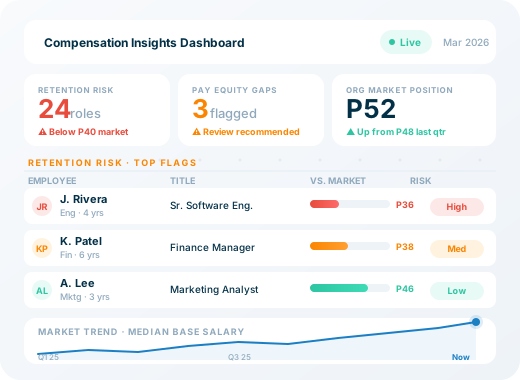
Compensation insights dashboard showing retention risk, pay equity analysis, and market positioning
The signals are there. You just cannot see them.
Flight risk icon
Invisible flight risks
Employees rarely announce they are underpaid before they leave. By the time you know, it is too late to act.
Pay equity blind spots icon
Pay equity blind spots
Without the right tools, pay disparities go undetected until they become legal or reputational issues.
Data without context icon
Data without context
Raw comp data is noise without context. You need to know not just where people are, but how they compare to market and what to do about it.
The Fundamentals

What is compensation analytics?

Compensation analytics is the practice of using data to understand, evaluate, and improve how an organization pays its people. It covers pay equity analysis, market competitiveness, retention risk, and the connection between compensation and workforce outcomes. For compensation teams, analytics transforms raw pay data into clear, actionable insights that support better decisions and stronger business cases.

The Process

How compensation insights work

From raw pay data to clear, actionable intelligence your team and leadership can act on.

1

Connect your workforce data

Bring in your employee pay data alongside your market pricing results and pay structures from across the Greatpoint HR platform.

2

Benchmark each employee to market and midpoint

Every employee is compared to both the external market reference for their role, level, and location, and the midpoint of their internal pay range. You see where they stand relative to the market and to internal comparisons at a glance.

3

Identify retention risk

Flag employees whose pay has fallen below key market thresholds where flight risk increases significantly.

4

Run pay equity analysis

Identify statistically significant pay gaps across gender, ethnicity, tenure, and other dimensions. Understand the drivers before taking action.

5

Build the business case

Quantify the cost of inaction: turnover exposure, adjustment budgets, and equity remediation estimates in one place.

6

Share leader-ready reports

Export clear, visual summaries formatted for leadership so insights get acted on, not filed away.

Compensation intelligence that drives action.
Greatpoint HR surfaces the insights that matter most so you can act before problems become costly.
Retention risk dashboard
See instantly which employees are below market at the threshold where flight risk increases. Act before you lose people you can't afford to lose.
Pay equity analysis
Identify statistically significant pay gaps across gender, ethnicity, tenure, and more. Get the data you need to close gaps and defend your decisions.
Market context overlays
Every data point benchmarked against current market rates, historical trends, and forward-looking forecasts so context is always built in.
Executive-ready reporting
Share clear, compelling comp insights with leadership without spending hours building decks. Greatpoint HR formats the story for you.
Common Use Cases

When teams turn to compensation insights

Whether you are preparing for a comp cycle or responding to a specific business question, Greatpoint HR gives you the data to act with confidence.

Identifying employees at retention risk before comp cycle
Running pay equity analysis ahead of reporting deadlines
Benchmarking pay after a reorg or job architecture change
Building the business case for adjustment budgets
Preparing a leadership compensation summary
Monitoring pay competitiveness throughout the year
Don't take our word for it
"No one does what you're doing. The dashboards are where the industry should go. I can see exactly where we stand across every market in seconds."
Director of Total Rewards
Financial Services
"Managing our structures in other tools was a tangle of chaos. Greatpoint HR's structure management is hands-down the best in the industry."
VP of Human Resources
Healthcare Organization
"It addresses every pain point we were having with our previous tool. The interface is clean and the support is genuinely human, not a bot."
Senior Manager, Global Compensation
Technology Company

How insights connect to market pricing and structures

Market pricing establishes what roles should pay. Structures define the ranges. Insights close the loop by comparing where your people actually sit relative to both. The result is a complete picture: you can see not just whether your ranges are market-competitive, but whether your actual pay decisions are landing where you intend. Greatpoint HR connects all three steps so comp teams can move from data to action without switching between tools.

FAQs

Compensation insights questions, answered

Common questions from comp teams about benchmarking, pay equity, and turning data into action.

Compensation benchmarking is the process of comparing your employees' actual pay to external market data to understand how competitive your pay is. It shows which employees or roles are above, at, or below market and helps prioritize where pay adjustments are needed.
Pay equity analysis examines whether employees in similar roles are paid differently based on characteristics like gender, ethnicity, or age that should not influence pay. It involves statistical analysis of pay data to identify gaps, understand their drivers, and determine what remediation is needed.
Retention risk in a compensation context refers to employees whose pay has fallen significantly below market rates, making them likely targets for competing offers. Employees paid below the 40th percentile of market are often considered at elevated risk. Identifying these employees early allows proactive intervention before turnover occurs.
Pay competitiveness is typically measured using compa-ratio (actual pay divided by range midpoint) and market ratio (actual pay divided by the market reference point). These ratios show how each employee or role is positioned relative to internal structures and external market benchmarks.
A strong compensation dashboard for leadership should show overall pay competitiveness versus market, headcount and pay distribution by level and function, pay equity summary with any identified gaps, retention risk flags by team or function, and budget impact of proposed adjustments. It should be visual, concise, and actionable.
Core benchmarking and equity analysis typically runs annually aligned to the comp cycle. Retention risk monitoring ideally runs continuously or quarterly given how quickly market conditions and headcount can shift. Ad hoc analysis is often needed for specific events like reorgs, rapid growth, or market disruptions.
Pay equality means everyone is paid the same regardless of role or performance. Pay equity means people in similar roles with similar experience and performance are paid fairly relative to each other, with differences explained by legitimate factors like scope, tenure, or location. Pay equity does not require identical pay, but it does require explainable pay.
Market pricing establishes what roles should pay. Structures define the ranges. Insights close the loop by comparing where your people actually sit relative to both. The result is a complete picture of whether your actual pay decisions are landing where you intend.

Book a Demo

See how Greatpoint HR helps compensation teams work smarter, move faster, and pay with confidence.
Book a Demo